Vitamin E: Daily Needs, Food Sources, and Why High-Dose Capsules Fell Out of Favour
In the 1990s vitamin E was the supplement many doctors took themselves. It is an antioxidant, observational studies linked higher intakes with less heart disease, and 400 IU capsules seemed a cheap insurance policy. Then the large randomised trials reported, and the story changed. Today the advice is almost the opposite of what it was thirty years ago: get vitamin E from food, which is easy, and be wary of high-dose capsules.
What vitamin E does
Vitamin E is the name for a group of fat-soluble compounds, the tocopherols and tocotrienols. The one the body actually keeps and uses is alpha-tocopherol: the liver has a transport protein that picks it out and sends it into the bloodstream, while the other forms are mostly broken down and excreted. For that reason, official intake figures in Europe and the US count alpha-tocopherol only.
Its main job is to protect the fats in cell membranes from oxidation. The NHS summarises its role as helping to maintain healthy skin and eyes and to strengthen the immune system. It also has a mild effect on blood clotting, which turns out to matter at high doses.
How much you need
As with vitamin K, the data are not good enough to calculate an average requirement, so European and US bodies work from what healthy people eat without signs of deficiency. The figures differ more than for most nutrients:
| Body | Adults | Notes |
|---|---|---|
| NHS (UK) | Men 4 mg, women 3 mg a day | Based on the UK's 1991 dietary reference values |
| EFSA (EU, 2015) | Men 13 mg, women 11 mg a day | Adequate intakes of alpha-tocopherol; no extra amount in pregnancy or breastfeeding |
| US National Academies (2000) | 15 mg a day | Recommended Dietary Allowance for men and women; the basis of the "% Daily Value" on US labels |
The spread reflects different methods rather than different biology: EFSA based its figures on average intakes in nine European countries, while the US value rests on older laboratory tests on red blood cells. The NHS adds a practical point: the body stores the vitamin E it does not need straight away, so you do not need it every day.
Where to find it
The NHS lists three groups of good sources:
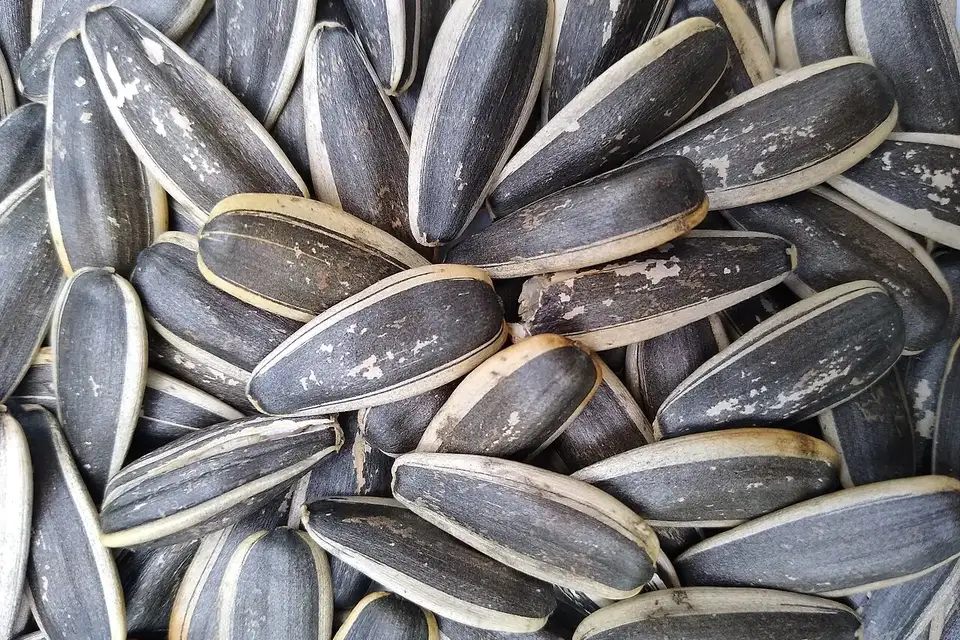
- Plant oils, such as rapeseed (sold as vegetable oil in the UK), sunflower, soya, corn and olive oil. Sunflower and wheatgerm oil are especially rich.
- Nuts and seeds: almonds, hazelnuts, sunflower seeds and peanuts are among the best.
- Wheatgerm, found in cereals and cereal products, and in smaller amounts in wholegrain bread and breakfast cereals.
Leafy greens, avocado and eggs add smaller amounts. Someone who cooks with vegetable oil and eats a handful of nuts or seeds a few times a week is very unlikely to be short.
Who can run short
Deficiency from diet alone is very rare in healthy adults. It is seen mainly in three situations:
- Poor fat absorption, as in cystic fibrosis, some liver and pancreatic diseases, Crohn's disease, or after some types of weight-loss surgery.
- Premature babies, who are born with small stores; neonatal units manage this through their feeding protocols.
- A rare inherited condition, ataxia with vitamin E deficiency, in which the liver transport protein does not work, so very high doses are needed for life.
When deficiency does develop, it mainly affects nerves and muscles: loss of feeling in the hands and feet, unsteady walking, muscle weakness and eye problems. Any of them deserves a medical assessment rather than a self-prescribed supplement.
Natural, synthetic and "IU" on the label
Supplement labels can be confusing because two forms are sold and two units are used.
- Natural vitamin E is listed as d-alpha-tocopherol or RRR-alpha-tocopherol.
- Synthetic vitamin E is listed as dl-alpha-tocopherol or all-rac-alpha-tocopherol. It is a mixture of eight closely related molecules, only some of which the body retains well, so it is less potent weight for weight.
Labels often give the dose in international units (IU). Under the US conversion factors, 1 IU of natural vitamin E equals 0.67 mg of alpha-tocopherol and 1 IU of the synthetic form equals 0.45 mg. A "400 IU" capsule therefore contains about 268 mg of alpha-tocopherol if it is natural and 180 mg if it is synthetic. Either way, that is many times the daily needs above.
What the big trials found
The hope that vitamin E capsules would prevent heart disease and cancer was tested in tens of thousands of people, with disappointing results.
- Heart disease and stroke. In the Physicians' Health Study II, about 14,600 US male doctors took 400 IU of vitamin E every other day or a placebo for a mean of eight years. Vitamin E made no difference to heart attacks, strokes overall or cardiovascular deaths, but it was associated with a higher risk of haemorrhagic stroke (bleeding in the brain).
- Prostate cancer. The SELECT trial gave 35,533 healthy men selenium, vitamin E (400 IU a day of the synthetic form), both, or placebo. After longer follow-up, the men taking vitamin E alone had a 17% higher risk of prostate cancer than those on placebo, an absolute increase of 1.6 cases per 1,000 men per year.
- Multivitamins. The low doses of vitamin E in ordinary multivitamins are not linked to these harms, but nor have they shown clear benefits for heart disease or cancer; see do multivitamins work?
There are two narrower areas where vitamin E has a place, both under medical supervision. In the US Age-Related Eye Disease Study, a formula containing 400 IU of vitamin E alongside vitamin C, zinc and other nutrients slowed progression in people who already had intermediate age-related macular degeneration, or the advanced form in one eye; it is not a preventive supplement for healthy eyes. And in a trial of people with mild to moderate Alzheimer's disease, 2,000 IU a day slowed the decline in everyday activities compared with placebo. Neither finding supports taking vitamin E capsules routinely.
Is too much a problem?
Yes, from supplements. Vitamin E from food is not a concern, but high doses interfere with blood clotting, and that is the effect regulators use to set limits. In 2024 EFSA reviewed the evidence on bleeding, cardiovascular disease and prostate cancer and kept the upper level for adults at 300 mg a day of alpha-tocopherol, including during pregnancy and breastfeeding. It noted that this limit does not protect people taking anticoagulant or antiplatelet medicines, such as warfarin or aspirin, for whom lower doses may already be unsafe. The NHS says that 540 mg (800 IU) or less a day of vitamin E supplements is unlikely to cause harm, while acknowledging that the long-term effects of high doses are not well known. The US upper limit is higher, at 1,000 mg a day of supplemental alpha-tocopherol.
Our page on upper limits compares vitamin E with the other nutrients where supplements can tip intake into the harmful range. If you take a blood thinner, are about to have surgery, or are being treated for cancer, tell your doctor or pharmacist about any vitamin E supplement you use.
In short
- Adults need roughly 3 to 15 mg of vitamin E a day depending on which authority you follow; a varied diet with plant oils, nuts and seeds provides it.
- Deficiency is rare and is mostly linked to conditions that stop fat being absorbed.
- On labels, 400 IU means about 180 to 268 mg, far above daily needs.
- Large trials found no protection against heart disease and an increased risk of prostate cancer with 400 IU a day.
- Stay below the upper limit, and talk to a doctor before taking vitamin E if you use any blood-thinning medicine.
This page is general information, not medical advice. If you have a condition that affects fat absorption, take anticoagulant or antiplatelet medication, or have been advised to take vitamin E for an eye or neurological condition, follow the guidance of your doctor or pharmacist.
Sources
- NHS, Vitamins and minerals: vitamin E.
- EFSA Panel on Nutrition, Novel Foods and Food Allergens. Scientific opinion on the tolerable upper intake level for vitamin E. EFSA Journal 2024;22(8):8953.
- Klein EA, Thompson IM, Tangen CM, et al. Vitamin E and the risk of prostate cancer: the Selenium and Vitamin E Cancer Prevention Trial (SELECT). JAMA 2011;306(14):1549–1556.
- EFSA Panel on Dietetic Products, Nutrition and Allergies. "Scientific opinion on dietary reference values for vitamin E as α-tocopherol". EFSA Journal 2015;13(7):4149.
- Sesso HD, Buring JE, Christen WG, et al. "Vitamins E and C in the prevention of cardiovascular disease in men: the Physicians' Health Study II randomized controlled trial". JAMA 2008;300(18):2123–2133.
- Institute of Medicine (US). Dietary Reference Intakes for Vitamin C, Vitamin E, Selenium, and Carotenoids. National Academies Press, 2000.
- Dysken MW, Sano M, Asthana S, et al. "Effect of vitamin E and memantine on functional decline in Alzheimer disease: the TEAM-AD VA cooperative randomized trial". JAMA 2014;311(1):33–44.
 Nutrition
Upper limits: when supplements can harm
What tolerable upper intake levels are, the nutrients most often taken in excess, and drug interactions.
 Nutrition
Do multivitamins work?
What Physicians' Health Study II, COSMOS and the USPSTF found for cancer, heart disease and memory.
 Nutrition
Vitamin K
The clotting vitamin: K1 versus K2, why leafy greens matter, the newborn injection, and why warfarin users should keep vitamin K steady rather than avoid it.